

Why Your Business Can’t Afford to Skip Commercial AC Service
Commercial AC service is the routine inspection, maintenance, repair, and replacement of heating and cooling systems in business properties — and doing it regularly is one of the smartest ways to cut operating costs.
Here’s what it typically includes:
- Preventative maintenance – scheduled tune-ups to keep systems running efficiently
- Repairs – fixing issues like refrigerant leaks, blower motor failures, and electrical faults
- Installation and replacement – upgrading aging or inefficient equipment
- Indoor air quality (IAQ) services – filtration, ventilation, and purification improvements
- Emergency service – rapid response when a system fails unexpectedly
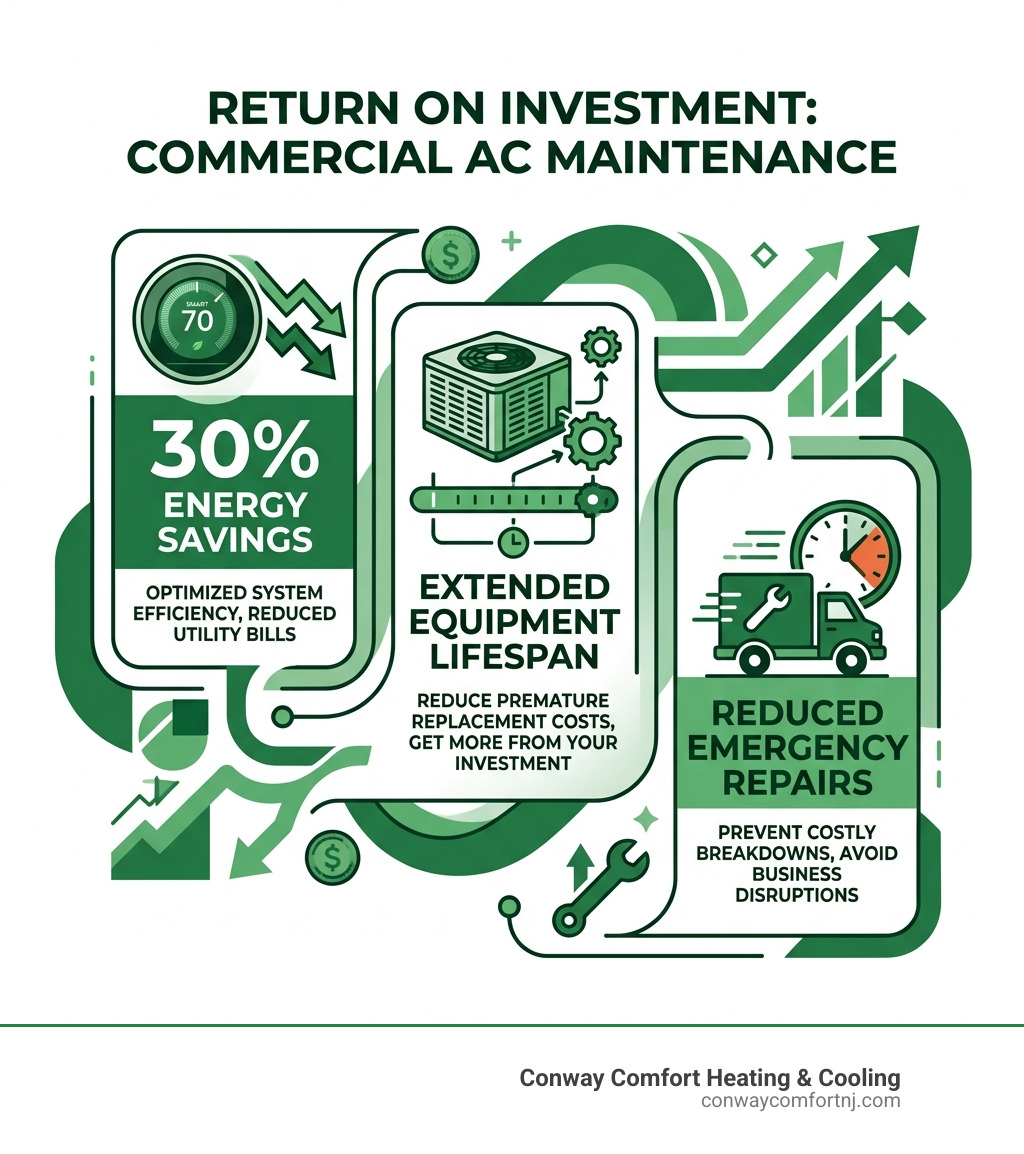
For businesses in Hamilton Township, NJ, a failing AC system isn’t just uncomfortable — it disrupts operations, drives up energy bills, and can push customers and employees right out the door. According to industry data, regular professional maintenance alone can reduce energy costs by up to 30% and significantly extend the life of your equipment.
The stakes are high. Commercial HVAC systems are responsible for nearly half of the energy consumed in commercial buildings. Neglecting routine service turns a manageable overhead cost into an expensive emergency.
I’m Brian Conway, owner of Conway Comfort Heating & Cooling, and since founding the company in 2011, I’ve helped businesses across East and West Windsor, NJ maintain reliable commercial AC service that keeps operations running smoothly year-round. I’ll walk you through exactly what’s involved and how to make it work for your bottom line.
Understanding the Scope of Professional Commercial AC Service
When we talk about commercial HVAC, we aren’t just talking about a larger version of your home’s air conditioner. These systems are massive, intricate networks designed to handle the heavy-duty cooling needs of business environments. In Mercer County, we see everything from sprawling retail spaces to multi-story office complexes, each requiring a tailored approach to climate control.
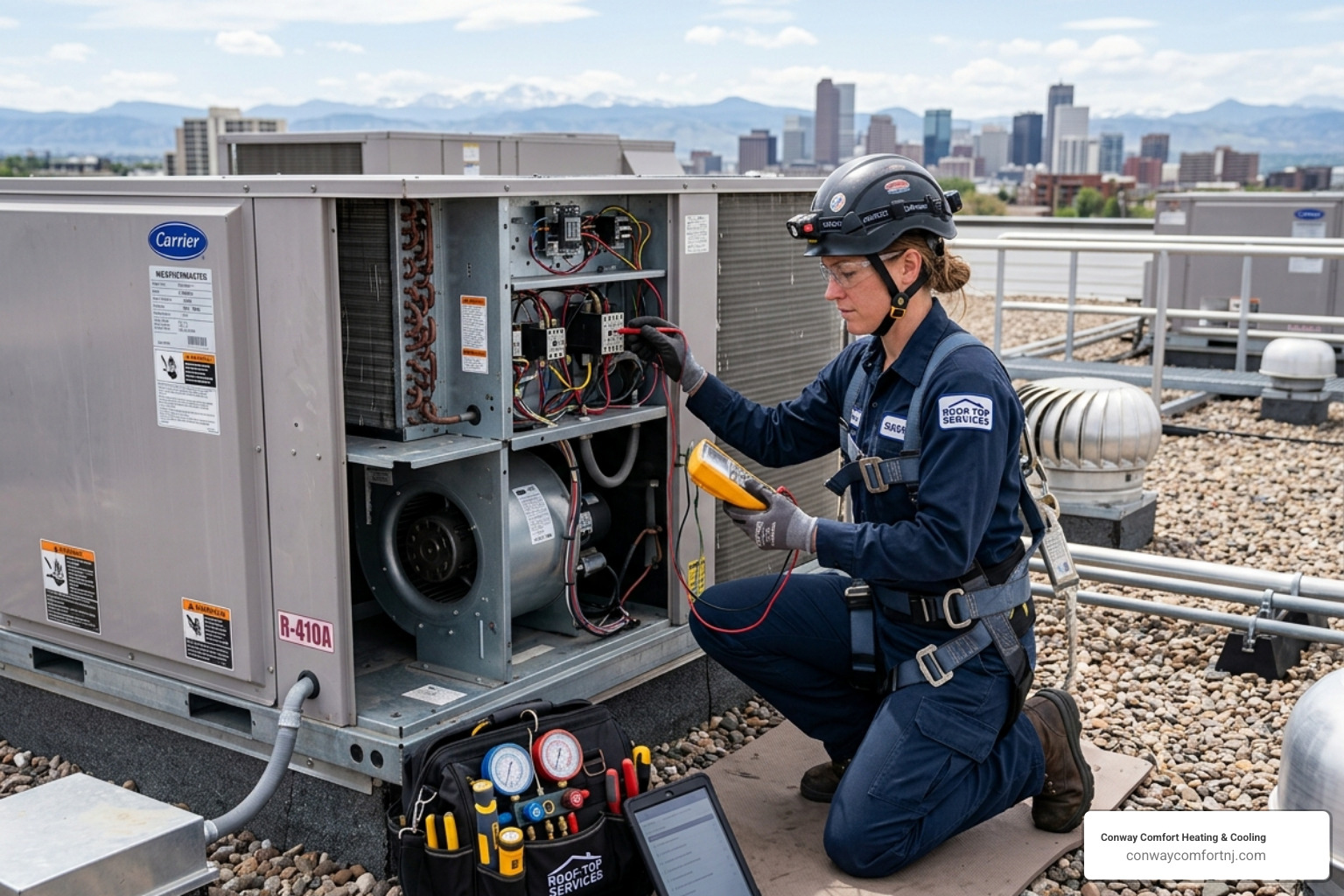
Professional commercial AC service covers a wide variety of equipment types. You might have a rooftop unit (RTU), which is a “packaged” system where all components are housed in one cabinet on the roof to save indoor space. Or, your building might utilize a Variable Refrigerant Flow (VRF) system, which is highly efficient because it can provide cooling to one zone while heating another. Larger industrial facilities often rely on chillers, which use water or a liquid medium to provide cooling across massive square footage.
Each of these systems requires a specific set of tools and diagnostic knowledge. A technician performing a multi-point inspection isn’t just checking if the air is cold; they are analyzing system pressures, testing electrical draws on heavy-duty capacitors, and ensuring that the complex logic boards controlling these units are communicating correctly.
Commercial vs. Residential Systems: Why Specialized Expertise Matters
One of the biggest mistakes a business owner can make is hiring a residential-only technician for a commercial job. The tonnage requirements alone are vastly different. While a typical home might need a 3-to-5-ton unit, commercial systems can easily reach 25 tons or more.
The complexity of the ductwork is another factor. Commercial buildings often have intricate “zoning” systems that allow different rooms to maintain different temperatures. If a technician doesn’t understand the nuances of commercial dampers and actuators, they could inadvertently cause a pressure imbalance that damages the entire system. Furthermore, businesses have 24/7 operational demands. If a server room AC fails at 2:00 AM, it’s an emergency. Specialized commercial expertise ensures that the technician understands the urgency and has the heavy-duty parts on hand to get you back up and running.
Specialized Commercial AC Service for High-Stakes Industries
Certain industries in Central New Jersey have zero margin for error when it comes to climate control.
- Data Centers: These facilities generate immense heat. Without precise thermal management, servers can overheat in minutes, leading to data loss and massive downtime.
- Healthcare Facilities: Here, commercial ac service isn’t just about comfort; it’s about safety. Operating rooms and laboratories require specific Indoor Air Quality (IAQ) and humidity levels to prevent the growth of pathogens.
- Education Facilities: Schools in areas like Lawrence or Princeton need reliable ventilation to keep students focused and healthy. High-occupancy classrooms require high-volume air exchanges that residential systems simply can’t provide.
How Preventive Maintenance Drives Down Business Costs
The phrase “if it ain’t broke, don’t fix it” is a dangerous philosophy in the business world. Waiting for your AC to fail before calling for commercial AC service is the most expensive way to run a building.
Statistical data shows that regular professional maintenance can reduce energy costs by up to 30%. When filters are clean, coils are scrubbed, and motors are lubricated, the system doesn’t have to work as hard to reach the desired temperature. This efficiency shows up directly on your monthly utility bill. The U.S. Department of Energy also notes that proper HVAC maintenance and efficiency improvements can help lower building energy use over time: U.S. Department of Energy – Heating and Cooling.
Beyond energy, there is the factor of equipment lifespan. A well-maintained commercial system typically lasts 10 to 15 years. Without routine care, that lifespan can be cut short by 25% or more. Replacing a 20-ton rooftop unit five years early is a capital expenditure most businesses would rather avoid.
| Feature | Maintained System | Neglected System |
|---|---|---|
| Energy Efficiency | High (Up to 30% savings) | Low (Strained operation) |
| Lifespan | 12-15 Years | 7-10 Years |
| Emergency Repairs | Rare | Frequent during peak season |
| Air Quality | Clean and filtered | Potential for mold/dust buildup |
| Operational Costs | Predictable budget | Unpredictable spikes |
To keep your system in top shape, it’s important to know how often you need your commercial HVAC inspected. Regular check-ups prevent breakdowns during the peak cooling season in July and August when the New Jersey humidity is at its worst.
The Impact of Regular Tune-ups on Equipment Lifespan
Think of a tune-up as an oil change for your building. During a standard commercial AC service visit, we focus on several key areas:
- Component Lubrication: Moving parts like fans and bearings create friction. Proper lubrication prevents heat buildup and mechanical failure.
- Coil Cleaning: Dirty condenser coils can’t release heat efficiently. Cleaning them restores the heat-exchange process and reduces the load on the compressor.
- Refrigerant Levels: Even a small leak can cause the system to freeze up or burn out the compressor. We check for leaks and ensure the charge is exactly where it needs to be.
- Electrical Connections: We inspect wires for signs of fraying or “hot spots” using thermography to catch electrical faults before they cause a fire or a short circuit.
- Belt Replacements: Worn belts can snap, causing the entire blower assembly to stop. Replacing them proactively costs pennies compared to a mid-summer emergency repair.
For businesses in the Mercer County area, industry experts emphasize that these small steps prevent the “domino effect” where one small failure destroys a multi-thousand dollar component.
Signs Your Business Needs Professional Attention
Your HVAC system usually tries to tell you it’s struggling long before it actually quits. Recognizing these signs early can save you from a total shutdown.
- Inconsistent Temperatures: If the conference room is a freezer but the lobby is a sauna, your system likely has a zoning issue or a failing blower motor.
- Strange Noises: Squealing, grinding, or banging sounds often point to loose belts or failing bearings.
- Rising Utility Bills: If your energy costs are creeping up but your usage hasn’t changed, your system is losing efficiency.
- Frequent Cycling: If the AC turns on and off every few minutes, it could be oversized for the space or suffering from a faulty thermostat.
- Poor Airflow: If you can barely feel air coming out of the vents, you might have clogged filters or leaking ductwork.
If you notice these issues, it’s time to call for expert AC repair. Ignoring a refrigerant leak or a funny noise today can lead to a dead compressor tomorrow.
When to Choose Repair vs. Replacement for Commercial AC Service
Deciding whether to sink money into a repair or invest in a new system is a major financial decision. We generally suggest the “10-year rule.” If your system is over a decade old and the repair cost is more than 50% of the value of a new unit, it’s time to replace it.
Modern high-efficiency systems offer an incredible ROI. For example, switching to a high-efficiency heat pump can reduce CO2 emissions by up to 60% and cut heating costs by up to 53% compared to older gas-fired units. These “green” upgrades aren’t just good for the planet; they are excellent for your bottom line and help your business comply with evolving energy regulations in New Jersey.
If you are located in areas like East Windsor or Lawrence, upgrading to a system with intelligent controls allows you to monitor energy usage in real-time, giving you even more control over your overhead.
Enhancing the Workplace with Indoor Air Quality Solutions
Indoor Air Quality (IAQ) has become a top priority for business owners. Poor air quality leads to “Sick Building Syndrome,” where employees experience headaches, fatigue, and increased absenteeism.
We offer several IAQ solutions as part of our commercial AC service:
- High-Efficiency Filters: MERV (Minimum Efficiency Reporting Value) ratings tell you how well a filter catches particles. While residential systems use low MERV filters, commercial spaces benefit from MERV 13 or higher to trap viruses and allergens.
- UV Purification: We can install UV-C lights inside your air handler. These lights destroy the DNA of mold, bacteria, and viruses as they pass through the system.
- HEPA Filtration: For healthcare or high-tech manufacturing, HEPA filters remove 99.97% of particles as small as 0.3 microns.
- Humidity Control: Maintaining humidity between 40% and 60% makes the air feel cooler and prevents the spread of airborne illnesses.
Improving your IAQ doesn’t just help your team breathe easier; it also protects your equipment. Clean air means less dust buildup on your internal components, which keeps your system running efficiently for longer.
Frequently Asked Questions about Commercial HVAC
What size AC unit does my business need?
Sizing a commercial unit is much more complex than just looking at square footage. While a general rule of thumb is 1 ton of cooling capacity per 400-600 square feet, we also have to consider:
- Occupancy Loads: How many people are in the building? (People generate heat!)
- Equipment: Do you have ovens, computers, or heavy machinery?
- Insulation and Windows: Large storefront windows in a retail shop in Hamilton will require more cooling than a windowless warehouse.
How often should I schedule a commercial HVAC inspection?
For most businesses in Central NJ, we recommend quarterly maintenance. At a minimum, you should have a seasonal tune-up in the spring (for cooling) and fall (for heating). High-traffic environments like restaurants or schools may need monthly filter changes to stay compliant with health codes and maintain airflow.
What should I expect during a commercial service consultation?
When we visit your site, we don’t just look at the unit. We perform a full system diagnosis, which includes:
- Energy Audit: Identifying where you’re wasting money.
- Transparent Pricing: Providing a clear, upfront quote with no hidden fees.
- Safety Protocols: Ensuring all work meets local New Jersey building codes.
- Project Timelines: Giving you a clear idea of how long a repair or installation will take so you can plan your operations accordingly.
Conclusion
At Conway Comfort Heating & Cooling, we know that your business depends on a comfortable environment. Whether you’re running a busy restaurant in Hamilton Township or managing a school in Mercer County, our goal is to provide commercial ac service that is reliable, transparent, and focused on your success.
We’ve been serving the Central New Jersey community for years, offering everything from emergency repairs to full system design and installation. Our 24/7 customer-focused service means that when you have a cooling crisis, we’re just a phone call away.
Don’t let a neglected HVAC system drain your profits. Schedule your commercial AC service today and let us help you keep your cool, no matter what the Jersey summer throws at you.
The post Why Regular Commercial Heating and Cooling Service Saves You Money appeared first on Conway Comfort Heating & Cooling.